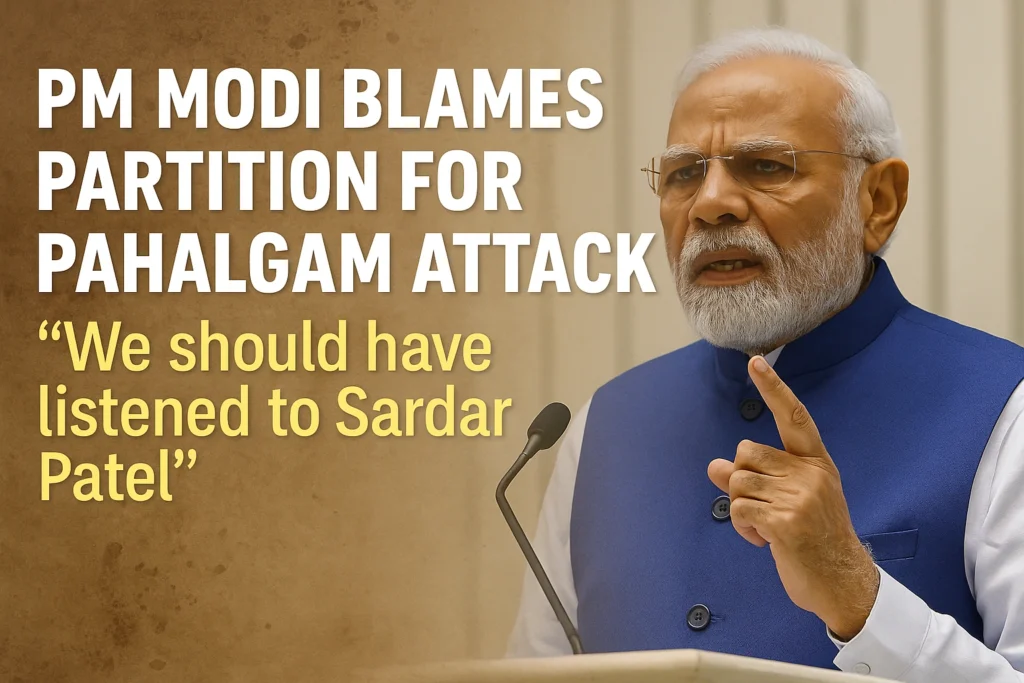
Gandhinagar, Gujarat – Prime Minister Narendra Modi, during a public address in Gandhinagar on Tuesday, reflected on the tragic terror attack in Pahalgam that claimed 26 lives last month, linking the roots of such violence to the decision of Partition in 1947. Speaking on the second day of his Gujarat visit, the Prime Minister underscored historical missteps and urged the nation to draw lessons for a stronger, more secure future.
Partition Regret and Patel’s Vision
Referring to the 1947 Partition as a moment where India “cut its own chains,” PM Modi argued that the country’s division led to long-term instability and the rise of terrorism, particularly in Kashmir. He lamented that Sardar Vallabhbhai Patel’s advice at the time—to pursue complete military action in reclaiming what is now Pakistan-occupied Kashmir—was ignored.
“If Sardar Patel’s counsel had been followed, history could have taken a different turn,” Modi said, adding that the first seeds of terrorism in Kashmir were sown immediately after the Partition.
Pahalgam Attack: A Reminder of Past Inaction
The Prime Minister linked the recent Pahalgam attack, which targeted a bus carrying mostly tourists, to the unresolved issues of the past. “What happened in Pahalgam is not isolated—it’s a continued echo of decisions we failed to make decades ago,” he stated.
Modi highlighted how, over the decades, India has consistently defeated Pakistan in traditional warfare. “They know they can’t win against our forces in direct war,” he said. “That’s why they’ve resorted to supporting terrorism as part of their strategy.”
Post-Attack Response: Operation Sindoor
Following the Pahalgam attack, India launched Operation Sindoor on May 7, a swift and calculated counter-strike on multiple terror camps across the border. Over four days, military operations escalated between India and Pakistan, culminating in a mutual cessation of military action on May 10.
Modi stressed that the world must recognize that Pakistan’s support for terrorism isn’t merely a proxy war, but a deliberate, state-backed strategy. “When terrorists killed during the operation were given military salutes and their coffins wrapped in Pakistan’s flag, it was a clear admission of intent,” he said. “This is not shadow warfare—it is war in plain sight.”
India’s Military Resolve
Emphasizing the might of India’s armed forces, Modi assured that any aggression would be met with an unflinching response. “We don’t want conflict. India has always believed in peace,” he said. “But if war is imposed on us in the form of terrorism, our answer will be strong and decisive.”
He reiterated that India’s strength lies not just in its military but also in its people’s spirit and resilience. “The country does not tolerate threats. And the world is beginning to understand that.”
A Vision of Economic Power
Alongside national security, the Prime Minister also addressed India’s meteoric economic growth. “When I first became Prime Minister in 2014, India’s economy was ranked 11th globally,” he said. “Today, we’ve risen to the 4th position.”
Modi highlighted the symbolic importance of surpassing former colonial power Britain in global economic rankings. “From being ruled for 250 years to overtaking our colonizer—it’s a journey of pride and determination.”
With renewed focus, Modi set the tone for India’s economic ambition: becoming the third-largest economy in the world. “This country is no longer willing to wait. We want progress, prosperity, and a place of leadership on the global stage,” he added.
India@2047: A Developed Nation Goal
As part of his long-term vision, the Prime Minister reiterated the government’s target of transforming India into a developed nation by 2047 — marking 100 years of independence. “There’s a new energy in the country,” he said. “Everywhere I go, I hear people say, ‘Modi hai to mumkin hai’ — and that faith is what fuels our mission.”
Conclusion
PM Modi’s address in Gujarat was more than a reflection on history or a reaction to terrorism—it was a roadmap for the future. By connecting the dots between past decisions, present challenges, and future goals, he called on the nation to remain resilient, alert, and united. From tackling terror to building a stronger economy, the Prime Minister made it clear: India’s story is still being written — and it will be one of strength, sovereignty, and success.